INTRODUCTION
Racial discrimination remains one of the most corrosive forms of social inequality because it combines visible difference with socially produced prejudice and institutional power[23]. Unlike isolated acts of rudeness or interpersonal conflict, racial discrimination repeatedly marks certain groups as outsiders, less deserving, suspicious, or inferior. Racial discrimination is best understood as unequal treatment or differential burden imposed on people because they are perceived to belong to a particular race, ethnicity, descent group, nationality, or phenotypic category[9, 23]. Racism produced classification that societies use to organize privilege and exclusion. It is an ideological practice that attaches superiority, inferiority, danger, or other social meanings to these classifications[26]. The Universal Declaration of Human Rights (UDHR) affirms that all human beings are born free and equal in dignity and rights[34], and the International Convention on the Elimination of All Forms of Racial Discrimination (ICEAFRD) defines racial discrimination as any distinction, exclusion, restriction, or preference based on race, colour, descent, or national or ethnic origin that impairs equal enjoyment of human rights[33].
The Constitution of India prohibits discrimination and guarantees equality before the law [3, 7, 24, 25]. However, caste hierarchy, colour prejudice, linguistic chauvinism, and regional stereotypes continue to shape the way many Indians experience belonging[10, 35]. This paper places this problem at the centre of a wide-ranging discussion on India, arguing that racial discrimination is not merely a foreign problem imported into Indian discourse but a deeply domestic concern that affects people from Northeast India and other stigmatized groups[17, 21, 28]. It may also be noted that the issue is not limited to prejudice in individual minds; it is reproduced through stereotypes, housing discrimination, workplace exclusion, sexual harassment, police apathy, and weak legal remedies[14, 11, 27].
While qualitative studies and policy reports have documented discrimination against Northeast Indians, comparatively few studies combine empirical survey evidence with theoretical analysis of structural racism and the social construction of race. This paper therefore addresses four linked questions. First, what is racial discrimination and how is it distinct from related forms of social exclusion? Second, how has racial discrimination manifested itself in India, especially in constitutional, legal, and social terms? Third, what are the specific forms of discrimination faced by people from Northeast India outside the region? Fourth, what do the survey findings and the larger documentary record suggest about the most effective responses?
Theoretical Framework
The paper is guided by two closely connected theoretical frameworks: the Structural Racism (Banton) and Social Construction of Race (Rattansi), to show that racism is not just prejudice but a social relation. Banton’s classic formulation treats racism as a doctrine that assigns behaviour to inherited characteristics and orders groups in relations of superiority and inferiority[2]. Banton argues that racism is not merely individual prejudice but a systemic structure embedded in institutions. Structural racism manifests in housing discrimination, employment exclusion and policing bias and unequal access to justice[2, 27]. Rattansi’s Social Construction of Race, stresses that racism is socially constructed, historically adaptive, and capable of changing form as societies change[26]. In India, racialization is often based on phenotypical markers, especially facial features and skin tone, which mark Northeast people as “foreign” or “non-Indian.” Together these perspectives show that racial discrimination may appear in overt forms such as slurs and physical assault, but it also appears in subtler forms such as exclusionary hiring, housing bias, stereotyping, and institutional neglect.
While delineating on the concept of racial discrimination, it is important to distinguish between direct and indirect forms of discrimination. Direct discrimination occurs when a person is openly denied a right, opportunity, or service because of racial identity. Indirect or systemic discrimination appears when apparently neutral rules, routines, or assumptions produce disadvantage for a racially marked group[33, 9]. This distinction is important because many discriminatory practices are not announced as racist. A landlord may not say “I do not rent to Northeast people,” but may refuse a rental after seeing the tenant’s appearance. An employer may not declare a racial rule, but may prefer candidates who fit a dominant cultural image[15-17]. A police officer may not state a bias, but may dismiss a complaint because the complainant is “from there” or “looks foreign.” In these situations, discrimination is embedded in ordinary institutional behaviour[15-17].
Racial Discrimination Against Northeast People
As stated earlier, racial discrimination is incompatible with India’s constitutional identity of equality [1, 7, 3, 18]. In practice, however, constitutional rights depend on enforcement, social awareness, and institutional capacity[20]. Similarly, there are many provisions in the Indian Penal Code, the Representation of the People Act, the Protection of Civil Rights Act, and related laws that penalize enmity, hostile speech, and discriminatory practices, are aimed specifically at removing discriminations on grounds such as race, caste, sex, language, disability, or tribe[12, 24, 25]. The broader implication is that Indian law recognizes pieces of the problem but lacks a fully integrated anti-racism framework[5].
The Indian Supreme Court in the Karma Dorjee & Others v. Union of India & Others, has acknowledged the seriousness of the issue of racial discrimination concerning Northeast citizens[13]. Yet the persistence of discrimination indicates a deeper mismatch between law on paper and law in practice.
The Northeast experience has become one of the most visible sites of racialization in contemporary India. People from the region are frequently misrecognized as foreign, variously identified as Chinese, Nepalese, or otherwise non-Indian, based on facial features, skin tone, dress, language, and cultural practices[11, 17, 28]. This persistent misrecognition reflects a broader social process in which phenotypical difference is mapped onto assumptions of national belonging, effectively racializing Northeast identities within the Indian social imagination[6, 11, 31]. Such perceptions are not merely superficial; they shape everyday interactions and reinforce the idea that Northeast Indians exist outside the normative boundaries of Indian identity[15-16].
This misrecognition is not simply insulting; it undermines the social basis of citizenship. When individuals are repeatedly asked where they are “really” from or whether they are “Indian,” their formal citizenship is symbolically downgraded in everyday life[15-17]. Scholars argue that this form of everyday exclusion constitutes a denial of substantive citizenship, where legal status is contradicted by social practices of exclusion and othering[15-17]. The resulting experience is one of conditional belonging, where Northeast Indians must constantly negotiate and defend their place within the nation[15-17].
People from the Northeast also suffer recurring forms of verbal and symbolic abuse. These include racial slurs such as “Chinky,” “Snake Eater,” and “Man-eater,” alongside stereotypes that portray Northeast women as sexually available or morally loose [4, 11]. Such expressions are not harmless jokes but forms of verbal violence that construct the body of Northeast people as exotic, inferior, or hypersexualized [11].
Evidence from multiple metropolitan contexts, demonstrates the wide geographic spread of such experiences [4, 22, 28]. For instance, in 2014, a student from Arunachal Pradesh lost his life after being racially attacked in broad day light in Lajpat Nagar, New Delhi[31]; during Covid-19- in Hyderabad, two men from Manipur were denied entry to a supermarket as they were dubbed, ‘not Indian’[29]; in Kolkata, 180 nurses from Manipur quit jobs in Kolkata hospitals over racial discrimination[32] and in New Delhi, a Northeast student was spat on and called “coronavirus” on campus[30]. And most recently, on December 24, 2025, a 24-year-old MBA student from Tripura, was killed in Dehradun, Uttarakhand, following a racially motivated attack[8] and on February 20, 2026, three women from Arunachal Pradesh were subjected to verbal abuse and racial slurs by their neighbours in South Delhi's Malviya Nagar[19]. These are but few of the many examples that reveal that racism is not limited to one city or one class of people. Together, these dynamics underscore that racialization in India is not an isolated or episodic phenomenon but an entrenched and recurring feature of social life, with significant implications for equality, dignity, and citizenship [4, 16-17].
METHODOLOGY
This paper uses a qualitative documentary research design, which itself combines conceptual discussion, legal analysis, case documentation, secondary reports, and survey evidence. In addition, the paper draws on official international and constitutional texts, Supreme Court materials, and the Bezbaruah Committee report to strengthen the analytical framework. The method is therefore best described as documentary analysis with descriptive synthesis of secondary data.
The empirical segment utilized a structured questionnaire comprising both closed-ended queries and a select number of multiple-choice questions, specifically crafted to elucidate respondents' encounters with racial discrimination, the modalities through which such discrimination manifested, reporting behaviors, perceived causative factors, and preferred policy interventions.
The empirical data of the study is a survey conducted from 16 August to 30 September 2025 among 1,178 respondents, based on a non-probability purposive sampling method supplemented by snowball recruitment, from Northeast India who are living in different parts of the country. The survey received 1,178 valid responses from approximately 1,420 responses, yielding an overall response rate of 82.9%. Of the 1,178 respondents, 69% were aged 19-25, 55% were women, and 71% were students. The sample is dominated by young migrants, a group especially vulnerable to harassment in cities because of dependency on rentals, campuses, coaching institutions, and low-paid work. Respondents were engaged through an online survey (using Google forms) disseminated via social media platforms, student organizations, Northeast community networks, alumni associations, and personal connections across various states of India. Participation in the survey was voluntary. Respondents were informed about the purpose of the study and participation implied informed consent. No personally identifying information was collected, and responses were anonymized before analysis. As the study involved minimal risk and anonymous survey responses, confidentiality and privacy were maintained throughout the research process. Instances of duplicate submissions were scrutinized, and incomplete responses were eliminated from the final dataset. The sample was geographically dispersed across Delhi, Punjab, Tamil Nadu, Maharashtra, West Bengal, Karnataka, Telangana, Uttar Pradesh, Uttarakhand and Andhra Pradesh.
The survey findings should be interpreted in light of certain limitations. First, although respondents were drawn from several Indian states, the sample was not nationally representative and relied partly on voluntary participation through community and student networks. Second, students constituted approximately 71% of the respondents, reflecting the demographic profile of Northeast migrants but limiting the generalizability of the findings to older professionals, long-term migrants, or non-student populations. Third, the study relied on self-reported experiences, which may be influenced by recall bias and subjective perceptions. Fourth, although respondents represented multiple states and union territories, the geographical distribution of participants was uneven, with greater representation from metropolitan destinations.
FINDINGS
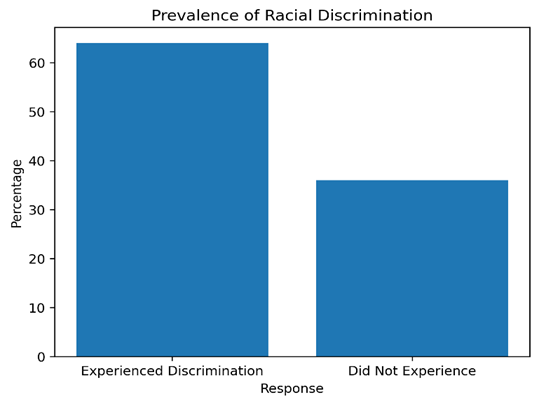
The survey data provide the clearest empirical window into the problem. The first major finding [Fig. 1] is high prevalence of racial discrimination. 64% of respondents said they had experienced racial discrimination outside the Northeast. That is a striking majority and suggests that discrimination is not rare, accidental, or but a widely distributed social experience. The finding aligns with the broader documentary evidence from city-specific incidents and with earlier studies cited in the report, including surveys of women migrants and urban migrants more generally.
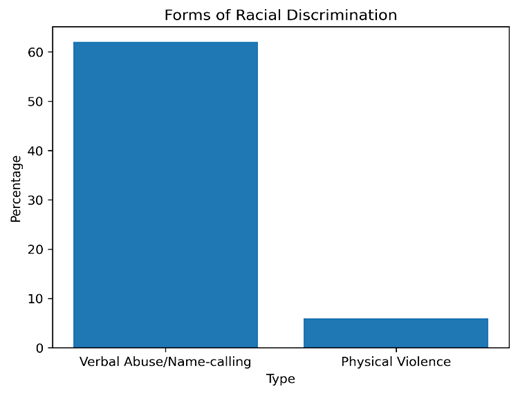
The second major finding concerns the dominance of verbal abuse and name-calling as the most common form of racial discrimination. 62% of respondents identified verbal abuse and name-calling as the most common form, while 6% identified physical violence. This indicates that the daily reality of racism is often verbal (humiliation, fear, and exclusion) and symbolic before it becomes physical.
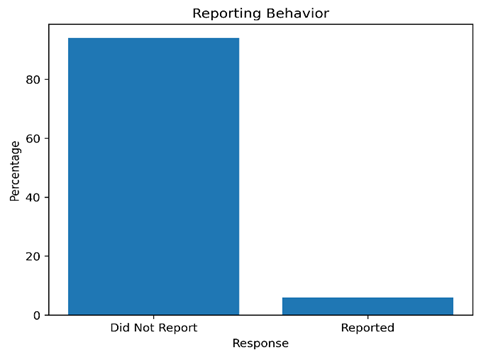
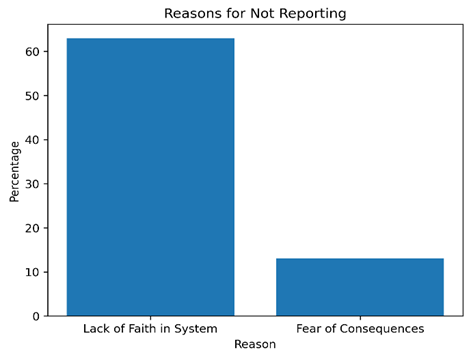
The third major finding is concerns reporting behaviour, i.e. underreporting [Fig. 3]. 94% of victims said they did not report incidents to police or NGOs, and only 6% did. Among those who did not report, 63% said they lacked confidence in the legal or redressal system, while 13% said they feared consequences [Fig. 4]. This is a critical finding because it reveals that the harm of discrimination is compounded by institutional silence. The extremely low reporting rate (94%) further illustrates the institutional dimension of structural racism. If racism were merely an interpersonal problem, victims would reasonably expect legal institutions to provide protection. Instead, the overwhelming lack of confidence in police and redressal mechanisms indicates that institutional responses themselves become part of the discriminatory experience.
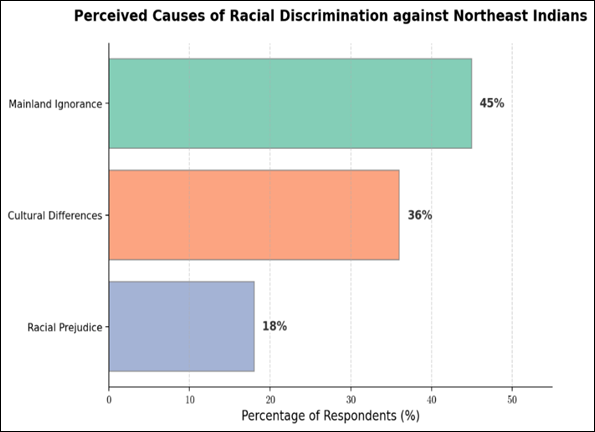
The fourth finding interprets the causes of discrimination [Fig. 5]. 45% of respondents attributed discrimination to mainland ignorance about Northeast India, 36% to cultural differences, and 18% to racial prejudice. This is significant in the light of Rattansi's Social Construction of Race, as most respondents blamed discrimination as being due to the lack of awareness about Northeast India (45%) and cultural differences (36%). Their answers indicate that racial discrimination is maintained not so much through the biological concept of race but rather through the socially defined perception of difference. The physical features, language, clothing, and cultural behaviors are observable characteristics that assume symbolic meaning and become criteria for defining the Northeast as an outsider. The results support Rattansi claims of race as a socially and historically constructed idea, showing that the feelings of being excluded are more likely to be due to people's perceptions of racial meanings based on physical and cultural differences in people than to an actual difference.
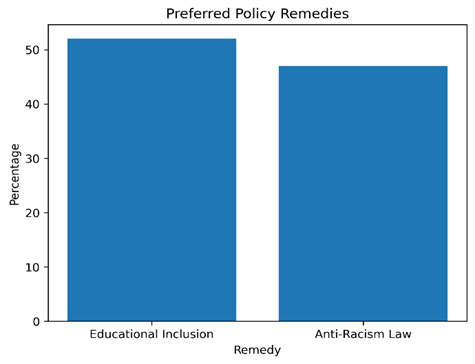
The fifth finding concerns remedies and the policy preference [Fig. 6] expressed by respondents to address the issue. 52% percent of respondents favoured inclusion of Northeast’s history, culture, and knowledge in the education system, while 47% supported stringent anti-racism legislation and strict implementation. This is a powerful policy signal because it shows that respondents want both cultural transformation and legal deterrence. The policy preferences expressed by respondents reinforce the theoretical framework. The survey therefore supports the view that effective anti-racism strategies must simultaneously change social attitudes and institutional practices. While educational inclusion addresses the social construction of race by challenging stereotypes and correcting historical ignorance, legal reform seeks to transform institutional structures that permit discrimination to persist.
The survey’s findings are corroborated by evidence from external studies and committee reports. The Jamia Millia Islamia/NCW study found that at least 60% of migrant women from the Northeast faced harassment and discrimination, with especially high levels of verbal abuse, landlord harassment, and molestation[20]. Discrimination cases were also reported the V.V. Giri National Labour Institute[36] and The North East Support Centre and Helpline report[22] and the Bezbaruah Committee[4].
In sum, the collective empirical evidence elucidates that the theoretical frameworks function not solely as descriptive models but as explanatory constructs. Banton's conceptualization of structural racism elucidates the persistence of discriminatory experiences across geographically disparate contexts, notwithstanding constitutional safeguards, whereas Rattansi's theoretical framework elucidates the manner in which Northeast Indians are persistently racialized through socially constructed notions of appearance, ethnicity, and national affiliation. Consequently, the survey findings enhance these theoretical perspectives within the Indian milieu by illustrating that race functions as a social construct rather than a biological classification, and that discrimination endures due to the continuous reproduction of these constructed identities by social institutions and quotidian interactions.
DISCUSSION AND CONCLUSION
The paper’s central conclusion is that racial discrimination against people from Northeast India is structurally embedded, not episodic, it is recurrent, patterned, and institutionally under-responded to. The first important conclusion of the study is that racial discrimination in India is structurally normalized. The study indicates that racism does not always appear in dramatic or spectacular forms. Instead, it is often embedded and normalized in routine interactions, at the marketplace, in campus corridors, in apartment buildings, in taxis, in hospitals, and on social media. Because these acts are repeated so often, they become part of the social environment.
This finding closely corresponds with Banton's conception of structural racism. The survey demonstrates that discrimination is not confined to exceptional incidents of physical violence but is reproduced through routine social interactions, housing practices, educational institutions, workplaces, and public services. The predominance of verbal abuse (62%) and the widespread experience of racial discrimination (64%) illustrate that racism has become normalized within everyday social relations.
The second implication is that citizenship is experienced unequally. A person from Northeast India may possess full legal citizenship, but social recognition can still be withheld. This creates a hierarchy of belonging in which some Indians are treated as insiders and others as conditional members. Such a hierarchy is damaging because citizenship is not only a legal status; it is also a social identity grounded in recognition.
A third conclusion concerns the failure of redressal systems. As stated earlier, the survey found that most of victims did not report racial discrimination to police or NGOs due lack of confidence in the legal system. It is evidenced that the state is not perceived as a dependable protector. In practical terms, this means many victims feel that reporting may lead to humiliation, delay, disbelief, or retaliation rather than justice. The result is a cycle in which discrimination remains hidden, unrecorded, and therefore easier for institutions to ignore.
The study also highlights the gendered nature of Northeast discrimination. Women experience not only racial slurs but also sexualized surveillance, harassment, and vulnerability in housing and public space. Gender intensifies racism because the body of a Northeast woman is often both racialized and sexualized.
Last but not the least, the study found out that education is necessary but not sufficient. Education alone cannot dismantle prejudice unless it is accompanied by legal deterrence and institutional reform. A school curriculum that celebrates diversity will have limited effect if landlords, police, employers, and campus authorities continue to tolerate racist conduct. Cultural inclusion and legal enforcement must therefore work together.
The Bezbaruah Committee recommendations remain highly relevant in this context. The committee called for a specific law or amendment to address racial incidents[4]. Likewise, the study drive home the point that while a dedicated anti-racism law would not solve the problem by itself, but it would create clearer legal recognition, stronger reporting pathways, and sharper public awareness. The study confirms the importance of having a dedicated Anti-Racism Act, which is focused on racial discrimination arising from ethnicity, physical appearance, regional origin and descent. Such law should be complementary, not supplanting existing guarantees under the Constitution of India, Article 14, 15, 19 and 21, and provisions of Bharatiya Nyaya Sanhita with respect to hate speech, public order. A separate law would offer easy ways for complainants to reach out to the relevant authorities, ensure that there are civil and criminal sanctions for violating the law, and mandate anti-discrimination policies in educational institutions, employers, landlords, and public authorities. A national or State level Anti-Discrimination Commission could help with investigation and mediation, raise awareness and monitor compliance. However, there would be implementation challenges, such as issues of under-reporting, lack of public awareness, evidentiary issues, and institutional resistance in terms of their understanding of racism as a separate social problem. Therefore, in addition to legislative reform, public education, police training, institutional accountability and a continuous awareness campaign are needed.
In fine, the study advances existing scholarship in three important respects. First, it provides one of the largest recent empirical datasets documenting the lived experiences of racial discrimination among people from Northeast India across multiple Indian states, thereby extending theoretical debates that have largely relied on qualitative case studies and isolated incidents. Second, the findings demonstrate that structural racism in India operates not only through institutional exclusion but also through routine interpersonal interactions, verbal abuse, housing discrimination, workplace practices, and institutional inaction, illustrating how these dimensions reinforce one another. Third, the study contextualizes global theories of race within the Indian socio-political setting, showing that racialization in India is by socially constructed perceptions of ethnicity, physical appearance, regional identity, and national belonging. The study therefore contributes empirical evidence that refines existing theoretical understandings of racism in multicultural democracies beyond the conventional Western context.
In conclusion, this paper argues that racial discrimination against people from Northeast India is a socially constructed and structurally sustained form of inequality. The evidence is clear: discrimination is common, verbal abuse dominates, non-reporting is widespread, ignorance is a major cause, and education plus strong law are the most supported remedies. A serious anti-racist response in India must therefore combine legal reform, curricular inclusion, administrative accountability, and a deeper cultural commitment to plural citizenship. India cannot fully realize its democratic ideals while one section of its citizens continues to live under the burden of being treated as outsiders in their own country.