INTRODUCTION
India’s rise in the Indian Ocean Region (IOR) is typically interpreted through the lenses of naval capability, geopolitical balancing, and strategic competition. Yet an important empirical puzzle remains insufficiently explained: how do states generate political authority and regional legitimacy in domains where coercion is neither feasible nor desirable? In particular, why do technical infrastructures—such as oceanographic data systems, early warning networks, and scientific training regimes—translate into durable forms of influence in regional governance?
In this study, political authority refers to the capacity of a state to shape governance practices and expectations within a regional order, while regional legitimacy denotes the recognition of this role by other actors and institutions. Embedded authority is conceptualized as a specific form of legitimacy that arises when a state’s technical systems and expertise become routinely integrated into the operational functioning of regional governance mechanisms.
Existing scholarship in International Relations (IR) offers partial answers. Constructivist approaches emphasize the role of norm diffusion and persuasion, while soft power frameworks highlight attraction and legitimacy through values and public goods provision. However, these perspectives tend to privilege discursive processes and ideational appeal, underestimating the material and institutional infrastructures through which authority becomes routinized and recognized. As a result, they struggle to explain why certain forms of technical cooperation—particularly in domains like ocean governance—generate sustained leadership claims, while others remain politically inconsequential.
This analysis addresses this gap by examining India’s oceanographic engagement in the IOR as a form of infrastructural–epistemic statecraft. It argues that influence in contemporary regional orders is increasingly produced not only through persuasion or coercion, but through the embedding of technical systems, data regimes, and operational practices into the everyday functioning of governance architectures. These infrastructures generate what may be termed “embedded authority”—a form of legitimacy that emerges from routinized dependence, institutional recognition, and the normalization of expertise. Rather than assuming a linear progression in which technical capability or normative persuasion directly produces influence, the framework emphasizes institutional embedding—the process through which technical systems, data flows, and operational practices become integrated into the routine functioning of regional governance, thereby generating durable forms of authority.
To explain this process, the Currents of Influence framework is, a three-stage model that traces how scientific capacity is translated into political authority through (1) knowledge production, (2) knowledge circulation, and (3) norm entrepreneurship. Moving beyond linear accounts of soft power or norm diffusion, the framework conceptualizes science diplomacy as a sequential and infrastructural process, in which authority is co-produced through the interaction of technical capability, institutional embedding, and normative framing.
Empirically, the research draws on qualitative analysis of policy documents, institutional reports, and multilateral engagements between 2015 and 2025 to examine India’s role in tsunami early warning systems, marine data-sharing platforms, and regional governance initiatives. It demonstrates how India’s oceanographic institutions—particularly the Indian National Centre for Ocean Information Services (INCOIS) and the Indian Tsunami Early Warning Centre (ITEWC)—function as sites where technical expertise is translated into diplomatic capital and regional legitimacy.
The present study makes three contributions. First, it advances IR theory by introducing the concept of infrastructural–epistemic authority, highlighting how material knowledge systems underpin normative power. Second, it refines constructivist and soft power approaches by showing that legitimacy is not merely discursively constructed but institutionally embedded through technical practices. Third, it contributes to scholarship on India’s foreign policy by demonstrating how ocean science operates as a strategic instrument of maritime governance and regional leadership. In doing so, the paper reframes science diplomacy not as a peripheral or cooperative add-on to statecraft, but as a central mechanism through which authority is produced, contested, and stabilized in contemporary international politics.
LITERATURE REVIEW
This study builds on constructivist International Relations scholarship, which emphasizes that influence is not derived solely from material capabilities but from the ability to shape norms, meanings, and expectations of legitimate behaviour[1]. In maritime governance contexts such as the Indian Ocean Region (IOR), where authority is diffuse and institutional structures remain fragmented, such processes are particularly significant. Complementing this, the literature on soft power highlights how states generate influence through attraction, credibility, and the provision of public goods[2]. Science diplomacy has often been situated within this framework, understood as the use of scientific cooperation to build trust, facilitate collaboration, and advance foreign policy objectives.
However, both constructivist and soft power approaches tend to privilege discursive and ideational processes, under-theorizing the role of material and institutional infrastructures in producing durable authority. While science diplomacy scholarship recognizes the strategic role of scientific collaboration[3, 4], it often remains descriptive, focusing on cooperation rather than on how such cooperation translates into sustained leadership and legitimacy.
This paper addresses this gap by conceptualizing science diplomacy as an infrastructural and epistemic process, through which technical systems, data regimes, and institutional practices become embedded within regional governance architectures.
Theoretical Framework: Infrastructural–Epistemic Authority and the Currents of Influence
While existing literature on constructivism and soft power provides important insights into how norms and legitimacy operate in international politics, it remains limited in explaining how technical and material infrastructures contribute to the production of authority. Norm diffusion models[1] emphasize persuasion and socialization, while soft power frameworks[2] privilege attraction and legitimacy through values. However, both approaches tend to treat material systems as secondary to ideational processes.
The concept of infrastructural–epistemic authority is introduced, defined as a form of political authority that emerges when knowledge-producing systems—such as data networks, early warning mechanisms, and scientific institutions—are not only technically credible but are routinely used, institutionally integrated, and recognized as indispensable within governance processes.
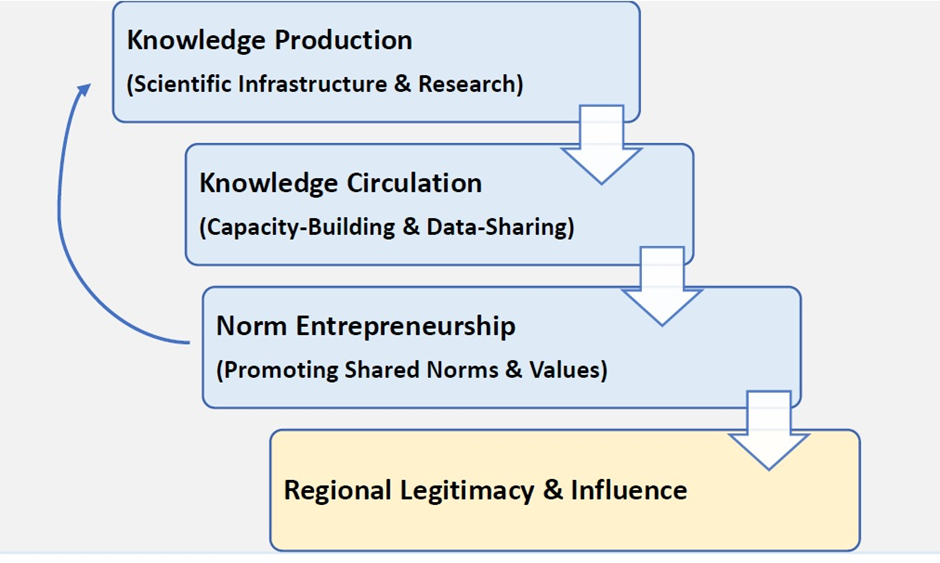
To operationalize this concept, the Currents of Influence framework is developed, which specifies a three-stage causal mechanism linking technical capacity to political authority. First, knowledge production establishes technical credibility through the generation of specialized expertise. Second, knowledge circulation extends this expertise beyond national boundaries, producing patterns of external reliance through data-sharing, training, and cooperative systems. Third, norm entrepreneurship frames these practices within broader governance narratives, enabling institutional recognition and legitimacy. Authority emerges not from any single stage, but from their sequential interaction. The framework consists of three interlinked stages:
Knowledge Production: The generation of specialized scientific expertise through technological infrastructure and research systems.
Knowledge Circulation: The dissemination of this expertise through data-sharing, training, and cooperative mechanisms that create patterns of reliance.
Norm Entrepreneurship: The framing of these practices within broader governance narratives, embedding values such as cooperation, stewardship, and shared responsibility.
This sequential relationship is illustrated in [Fig. 1]. Crucially, the framework departs from linear models of influence by emphasizing institutional embedding as the key mechanism linking technical capability to legitimacy. Authority, in this account, does not arise simply from possessing knowledge or advocating norms, but from becoming indispensable to the functioning of regional governance systems. In this framework, institutional embedding refers to the repeated uptake and integration of a state’s technical systems, data streams, and operational protocols by external actors and multilateral institutions.
This approach contributes to IR theory by bridging material and ideational perspectives, demonstrating that infrastructure and discourse are mutually constitutive in the production of political authority. It also provides a basis for analyzing variation: where knowledge systems fail to circulate or become institutionalized, claims to leadership are unlikely to be sustained.
Positioning Within International Relations Theory
This research is situated at the intersection of constructivist International Relations, science diplomacy scholarship, and emerging work on infrastructural power. It engages directly with three strands of literature. First, constructivist approaches emphasize that legitimacy and authority are socially constructed through norms, shared meanings, and processes of socialization[1]. While this perspective is foundational, it tends to privilege discursive and ideational mechanisms, often overlooking the material infrastructures through which norms are enacted and stabilized. The theory of constructivism is built upon, by arguing that norms acquire durability when embedded within technical systems and institutional practices, rather than existing solely at the level of discourse.
Second, the literature on soft power conceptualizes influence as the ability to shape preferences through attraction, credibility, and the provision of public goods[2]. However, soft power frameworks often treat legitimacy as an outcome of perception rather than as a product of operational dependence and infrastructural integration. This perspective is extended by demonstrating that technical systems—such as early warning networks and data platforms—generate influence not only by attracting partners, but by becoming functionally indispensable. Third, recent work on science diplomacy highlights the role of scientific cooperation in addressing transboundary challenges and facilitating international collaboration[3, 4]. While this literature recognizes the strategic dimensions of science, it often remains descriptive or policy-oriented. This paper contributes by theorizing science diplomacy as a form of infrastructural statecraft, linking it explicitly to questions of authority, legitimacy, and norm formation in IR.
By integrating these perspectives, a broader claim is advanced: authority in contemporary international politics is increasingly co-produced through the interaction of knowledge systems, institutional practices, and normative framing. This shifts the analytical focus from persuasion alone to the embeddedness of expertise within governance architectures, offering a more comprehensive account of how influence operates in domains such as the maritime commons.
METHODOLOGY
A qualitative research design is adopted, combining document analysis with interpretive process tracing. The objective is to examine how India’s oceanographic initiatives are framed, circulated, and translated into claims of authority and legitimacy within the Indian Ocean Region[5]. The empirical material consists of purposively selected documentary sources, including policy statements, ministerial speeches, institutional reports, parliamentary records, and multilateral declarations. Documents were selected based on two criteria: (a) explicit reference to ocean science or marine data systems, and (b) articulation of regional cooperation, governance, or leadership objectives.
Supplementary sources, including reports from organisations such as the Indian Ocean Rim Association (IORA), the International Energy Agency (IEA), and UNCTAD, are used to contextualise the strategic and environmental significance of the IOR. The primary period of analysis spans 2015 to 2025, capturing the evolution of India’s SAGAR vision, the growing institutionalisation of the Indo-Pacific discourse, and the expansion of regional ocean governance initiatives. This time-frame also reflects the post-2004 tsunami context in which early warning infrastructure and regional preparedness systems became central to Indian Ocean governance.
Documentary material was examined for recurring patterns in how India’s oceanographic initiatives were presented and operationalised, focusing on three dimensions mentioned earlier. Specific institutional practices are connected with broader diplomatic narratives about legitimacy and leadership in the maritime commons. A limitation is that it relies primarily on secondary literature and documentary evidence. Official documents may also reflect strategic self-representation. Nevertheless, triangulating governmental sources with academic scholarship and multilateral reports strengthens the reliability of the analysis.
The analysis proceeded in three stages. First, documents were coded deductively using sensitizing concepts derived from constructivist IR, including authority, legitimacy, norm articulation, and leadership claims. Second, inductive coding identified recurring themes such as public goods provision, shared vulnerability, and capacity-building. These were then grouped into three analytical categories: knowledge production, knowledge circulation, and norm entrepreneurship. Third, process tracing was used to examine sequential linkages between scientific initiatives, their circulation, and subsequent institutional or reputational outcomes. This approach enables one to move beyond descriptive accounts of cooperation and instead identify the mechanisms through which technical capabilities are translated into political authority. The following sections operationalize the three-stage process outlined in [Fig. 1], tracing how India’s oceanographic initiatives move from technical capability to embedded authority.
Knowledge Production
Science diplomacy has become increasingly important in addressing global challenges like climate change and maritime security[3]. India has leveraged its scientific capabilities in oceanography, meteorology, and technology to build cooperation across the Indian Ocean; which mainly centre around its national-level oceanographic agencies that operate robust observation networks. These capabilities include the Indian National Centre for Ocean Information Services (INCOIS) maintaining a number of Automated Weather Stations (AWS) and moored buoys in the Indian Ocean, which relay instantaneous meteorological and oceanographic data into forecasting models[6]. These AWS networks, 1,008 in operation as of 2025 according to India’s Ministry of Earth Sciences enable India’s forecasting system (INDOFOS) to improve climate and weather predictions[7].
India also contributes to global observation programs: it co-manages the RAMA (Research Moored Array for African-Asian-Australian Monsoon Analysis and Prediction) tropical moored buoy array with America’s National Oceanic and Atmospheric Administration (NOAA) and deploys Argo floats and drifting buoys for ocean data collection[8, 9]. Such sensors help understand the monsoon and cyclone dynamics, benefiting all IOR rim states.
An example of ship-borne science is the installation of an air–sea flux reference system aboard India’s oceanographic vessel ORV Sagar Nidhi[10]. INCOIS researchers equipped this vessel with eddy-covariance sensors and a high-precision weather station to directly measure turbulent heat and momentum fluxes over the Arabian Sea. The resulting data help validate climate and weather models, reducing uncertainty in ocean–atmosphere interactions. This reflects India’s plans to expand such measurements across the Indian Ocean, exemplifying the fact that India’s science diplomacy aims to enhance its global climate science, while demonstrating New Delhi’s leadership in ocean research.
India also operates advanced early-warning centres and shares those services regionally. After the 2004 tsunami, India set up the Indian Tsunami Early Warning Centre (ITEWC) at INCOIS, that issues real-time tsunami advisories and monitors earthquakes above magnitude 6.5 in this region. Since 2021, ITEWC has processed 145 potential tsunamigenic quakes (including 8 in the IOR) and dependably issued accurate warnings or “no-threat” advisories to coastal states. The fact that INCOIS goes beyond tsunamis and provides a suite of multi-hazard ocean services (cyclone forecasts, storm-surge alerts, wave and current advisories) showcases its growing prowess[7]. At this stage, India’s influence remains limited to technical credibility; while expertise establishes the foundation for authority, it does not by itself generate recognition or dependence.
Knowledge Circulation
Crucially, India extends these technical services internationally: INCOIS now delivers cyclone and tsunami alerts to Bay of Bengal littorals and organises regional mock drills (e.g. IOWave exercises) to strengthen preparedness[11, 12]. Such operational oceanography, a form of science diplomacy, aids India build goodwill by training its neighbours and sharing life-saving data, while also anchoring itself as a regional meteorological leader[13]. These practices are analytically significant because they produce operational dependence: regional actors begin to rely on Indian-generated data, forecasts, and training systems as part of their routine governance functions.
Capacity-building and scientific training further illustrate India’s ocean diplomacy. The INCOIS-run International Training Centre (ITCOocean) regularly hosts courses for foreign scientists. For instance, in September 2024 INCOIS held a specialized tsunami early-warning course for technical officers from Oman, covering tsunami science, observation systems, and alert dissemination[14].
Similarly, India–USA joint initiatives like EKAMSAT (Enhancing Knowledge of Arabian Sea Marine environment through Science and Advanced Training) bring together early-career researchers from India and partner countries. The 2025 EKAMSAT workshop, held in October in Hyderabad, trained ~30 young Indian and American scientists in open ocean processes, from shipborne observations to numerical modelling of the Arabian Sea and Bay of Bengal[11, 15]. This scientific outreach by way of shared databases, field programs, joint workshops, and technology transfers, advances marine science, while also strengthening diplomatic ties among IOR states.
Over time, these training networks generate what may be termed “institutional familiarity effects,” wherein regional meteorological and disaster management agencies integrate Indian data streams and protocols into their operational routines. This routinization creates patterned reliance, reinforcing India’s credibility as a dependable first responder and information hub.
India’s science diplomacy also supports the utilization of the ocean and coastal domains for sustainable economic growth through industries like fisheries, maritime trade, offshore energy, marine bio-technology, and ocean-based infrastructure. At the 2025 UN Ocean Conference, India’s Union Minister of Earth Sciences, Jitendra Singh, highlighted major projects, including over $80 billion in maritime and port investments, modernization under the Sagarmala port program, and a 10% year-on-year rise in marine fish production under the Pradhan Mantri Matsya Sampada Yojana (PMMSY), the country’s flagship fisheries development initiative[16]. These tangible achievements underscore how science-based policies (e.g. better fisheries management, coastal surveillance) can seamlessly align with the country’s growth and sustainability objectives.
India’s launch of the SAHAV ocean data portal, a GIS-based platform sharing real-time marine spatial data, is touted as a step toward science-based ocean planning; exemplifying how India is using data science and technology to make its ocean development more inclusive and environmentally informed[17].
Norm Entrepreneurship
Alongside science initiatives, India also places emphasis on norms and values in its maritime diplomacy. New Delhi frames the ocean as a ‘commons’ that belongs to all of humanity, drawing on the principles of the United Nations Convention on the Law of the Sea and broader sustainable development agendas. Indian leaders frequently articulate a moral-ideational vision, e.g., PM Modi’s address to the Mauritius National Assembly in March 2015 invoked trust and transparency, and respect for international maritime rules and norms as the foundation for regional cooperation[18].
Subsequent policy statements by key Indian officials, including the National Security Advisor Ajit Doval, Minister of External Affairs S. Jaishankar, and Defence Minister Rajnath Singh, have reiterated at various global fora that India seeks a peaceful order, freedom of the seas, and open sea-lanes as global public goods[19]. These formulations reflect a normative view that India sees itself as a stakeholder in preserving a rules-based maritime order where common resources (e.g. fisheries, sea routes, the marine environment at large) are governed equitably and collaboratively.
India reinforces this normative posture through multilateral platforms. As chair of the Indian Ocean Rim Association (IORA) for 2025–2027, for instance, India prioritizes ocean governance, infusion of ocean technologies along with data management, and disaster risk reduction in the IOR agenda[20]. Within IORA’s blue economy and climate discussions, New Delhi’s advocacy for principles such as sustainable development, marine biodiversity conservation, and capacity-building for vulnerable states is noteworthy.
The acceptance of ocean governance and disaster risk reduction as priority pillars during India’s IORA chairship further indicates that India’s normative framing resonates within multilateral agendas. While consensus-based institutions rarely attribute leadership explicitly, agenda-setting authority itself reflects a degree of recognition by member states.
Similarly, India has taken leadership roles in regional bodies like BIMSTEC (The Bay of Bengal Initiative for Multi-Sectoral Technical and Economic Cooperation), a seven-member grouping where environmental sustainability and disaster preparedness are some of their key work-streams. BIMSTEC’s disaster management exercises held in 2017, 2020, 2021, and 2025 all led by India, along with sharing of cyclone/tsunami forecasts to its Bay of Bengal neighbours via INCOIS bolsters the country’s image as a net security provider[21]. India engagement in global initiatives like the International Solar Alliance and the Coalition for Disaster Resilient Infrastructure, platforms whose climate and technology foci extend to oceanic concerns (coastal resilience, renewable energy at sea), are evidence of the same image-building effort[22]. The incorporation of these priorities into regional agendas indicates that India’s normative framing is not merely rhetorical but is reflected in agenda-setting outcomes within multilateral institutions.
In its law enforcement and diplomacy, India espouses norms of cooperation. New Delhi often contrasts this with a strictly realist mindset. In scholarly assessments, Indian policymakers emphasize that like all international law-abiding nations, India is particular about freedom of navigation in the maritime commons. India’s doctrine balances an anti-access/area-denial (A2/AD) mindset in the Indian Ocean with a line of thought that favours cooperation and contact with other navies[23]. This shift allows the India’s Navy and Coast Guard to participate in joint exercises centred on anti-piracy patrols, Search and Rescue drills with its littoral neighbours, and contribute to humanitarian assistance and disaster relief (HADR) missions in the IOR.
Hence, in normative terms, India projects itself not as a hegemon enforcing rules, but as a consensus-builder; a country appealing to shared values such as sea-blindness (equal access), and the idea of seeing the ocean as a ‘blue commons’ that must be preserved[24].
The ‘common heritage’ ethic also appears in India’s discourse on climate and ocean resources. Indian leaders invoke the idea of collective stewardship while recognizing that low-lying IOR states are existentially threatened. Case in point, a report tabled in the Indian Parliament in August 2025 underscored the need for greater strategic clarity and coordinated regional cooperation across the Indian Ocean, urging New Delhi to effectively align its maritime vision with practical mechanisms for collective response to shared challenges and opportunities in the maritime domain[25]. Indian proposals (sometimes in forums like IORA or as part of United Nations meetings) have included setting climate cooperation principles for the IOR, harmonizing disaster protocols, and ensuring equitable burden-sharing for adaptation[26]. These policy ideas frame climate change as a shared responsibility requiring normative commitments on data-sharing, open-access to early warnings, and joint science research. Thus, India advocates for resources of the high-seas and ocean resources to be managed under a set of rules, informed by science, sustainability, and fairness.
By referring to ocean resources as a common pool to be harnessed responsibly, India invites cooperative norms such as sustainable fisheries, marine spatial planning, coral conservation that align with international goals as outlined by SDG 14 i.e. Life Below Water and stated aims of the UNESCO Ocean Decade. The emphasis on science-grounded policymaking is meant to ensure that commitments are tangible, not fustian. As Bajpaee (2003)[27] notes, India’s rhetoric about maritime public goods such as secure sea lanes and a healthy ocean environment has grown since the 2000s. India now often sees itself as contributing to global public goods like maritime safety, rather than simply pursuing narrow national interests.
The Indian Tsunami Early Warning Centre: Demonstrating the Mechanism of Embedded Authority
The Indian Tsunami Early Warning Centre (ITEWC) provides a critical empirical test of the causal mechanism proposed in [Fig. 1]. Rather than serving as a descriptive illustration, this case demonstrates how technical capacity is translated into political authority through sequential institutional embedding.
Stage 1: Knowledge Production - Establishing Technical Credibility
Following the 2004 Indian Ocean tsunami, India invested in seismic monitoring systems, ocean buoys, satellite-linked communication networks, and real-time modelling infrastructure. These investments enabled ITEWC to generate high-frequency, reliable tsunami advisories based on scientifically validated detection systems. At this stage, India’s role was limited to that of a knowledge producer, with authority grounded primarily in technical competence rather than political recognition. At this stage, authority is grounded in technical competence but lacks regional recognition.
Stage 2: Knowledge Circulation – Producing Operational Dependence
The critical transition occurs when this capability is extended beyond national boundaries. India institutionalized the circulation of tsunami advisories to Indian Ocean littoral states, complemented by regular mock drills (IOWave), training programmes, and technical workshops. Over time, these practices produced operational dependence, as regional disaster management agencies began to integrate Indian data streams and alert protocols into their own emergency response systems.
This shift is analytically significant: influence here does not derive from persuasion or coercion, but from routine reliance on India’s technical systems during crisis situations. The repeated use of Indian-generated alerts normalizes its role as a central node in regional disaster governance. Repeated reliance on these systems transforms technical capability into operational centrality.
Stage 3: Norm Entrepreneurship – Securing Institutional Recognition
India consistently frames its early warning services as a regional public good, emphasizing shared vulnerability, cooperative security, and open data access. These normative claims, however, gain traction not in isolation, but because they are anchored in already operationalized systems of dependence. The result is not merely rhetorical alignment, but institutional recognition of India’s role within multilateral frameworks.
ITEWC’s designation as an official tsunami service provider under the Intergovernmental Oceanographic Commission exemplifies this transition from technical capability to recognized authority. At this stage, India’s leadership is no longer self-asserted; it is validated through incorporation into formal governance architectures. Institutional recognition formalizes this role, converting operational centrality into legitimate authority.
Outcome: Embedded Authority
The sequential interaction of these three stages produces embedded authority as conceptualized above. India’s influence emerges not from episodic intervention, but from its indispensability to the routine functioning of regional disaster governance systems. Authority, in this sense, is neither purely material nor purely ideational—it is co-produced through the integration of infrastructure, practice, and normative framing.
Scope Condition
Importantly, this mechanism is contingent. If knowledge circulation fails, either due to lack of trust, competing providers, or technological incompatibility, then technical capability alone is insufficient to generate authority. Similarly, without normative framing, operational dependence may not translate into legitimacy. The ITEWC case thus demonstrates not only how the mechanism works, but also the conditions under which it may break down.
Strategic Implications
These geopolitical dynamics can be reinterpreted through the lens of infrastructural–epistemic authority, where competition is not only over territory or influence, but over the control and circulation of knowledge systems.
The interplay of science diplomacy and normative messaging serves geo-strategic ends in the broader Indo-Pacific. While India has expanded its naval presence (e.g. Malabar exercises with the United States, patrols in the Bay of Bengal), it simultaneously invokes cooperative science narratives[28]. India promotes the Indo-Pacific as free, open, and inclusive, echoing its SAGAR creed, and backs this up with joint research projects e.g. US-India commercial space collaborations via the NASA-ISRO Synthetic Aperture Radar (NISAR) mission, and trilateral projects with France and Australia on regional maritime governance[29, 30]. In this sense, India’s maritime strategy is multi-dimensional. By championing shared values and knowledge, India seeks legitimacy and leadership in multilateral settings.
However, tensions persist between realpolitik and ideals. India’s ambitious plans (e.g. its blue economy projects and trans-oceanic infrastructure plans) could clash with conservation goals. For instance, port expansions may harm coastlines despite promises of inclusivity. India’s freedom of navigation emphasis aligns with Western powers but also risks entangling India in the U.S.-China great-power rivalry. Conversely, China’s own science diplomacy is rising, forcing India to respond both militarily and normatively[31]. In recent years, when China offered to build early warning systems for IOR states or increase its naval presence by sending oceanographic research vessels, Indian officials retorted that its Navy is tracking such activity which have the “potential to upset the delicate maritime balance in the IOR” [32, 33, 34].
This illustrates pragmatism: India’s climate and science diplomacy do not wholly replace hard power. Instead, they complement it by shaping the narrative. When China expands influence via development aid or scientific collaboration, India counters that with joint environmental initiatives and security dialogues, aiming to present itself as a champion of the region’s long-term welfare.
Another modern challenge is data geopolitics wherein states have started valuing the control of satellite and oceanographic data. India’s investments in space including Satellite with ARgos and ALtiKa (SARAL), a joint Indo-French satellite mission for oceanographic studies, Oceansat, a series of remote-sensing satellites to monitor oceanographic parameters, and cyber-capabilities for maritime monitoring reflect a recognition that information is strategic and multi-dimensional[35]. While India professes open data-sharing (as with SAHAV or global tsunami alerts), it also expands its own sensor networks to reduce dependence on foreign systems.
How India negotiates data access with China or Western powers, for example, in undersea cable security or ocean observation, will test its normative stance. But the current trajectory suggests India will leverage scientific partnerships e.g. with Japan’s Japan Agency for Marine-Earth Science and Technology (JAMSTEC), U.S. National Oceanic and Atmospheric Administration (NOAA), and European marine networks to sustain independent pools of ocean knowledge[36]. By blending data-sharing diplomacy, supported by adequate investments in home-grown technologies, India aims to make scientific knowledge a source of influence as well as resilience.
Soft Power and Geopolitical Competition: A Theoretical Tension
While India’s science diplomacy is often framed as soft power, its operation reveals a deeper strategic logic. Scientific infrastructure simultaneously generates cooperative legitimacy and strategic leverage. In the Indian Ocean, where maritime competition with China is intensifying, knowledge systems themselves become instruments of geopolitical positioning. Oceanographic research vessels, satellite systems, and data portals function both as public goods and as tools of infrastructural statecraft.
This creates a theoretical tension: science diplomacy projects inclusivity, yet it unfolds within a competitive geopolitical environment. India’s provision of early warning services and capacity-building workshops reinforces a narrative of responsible leadership, but it also establishes institutional centrality that may limit alternative influence pathways.
Normative Contestation with China
The rise of Chinese oceanographic expeditions and research vessel deployments introduces a dimension of normative contestation. Both India and China frame their maritime science initiatives as development-oriented and cooperative. However, Indian discourse frequently emphasizes transparency, rules-based governance, and multilateralism, implicitly contrasting its approach with perceived opacity in Chinese activities.
This contestation is not purely material but ideational. Competing narratives seek to define what constitutes legitimate maritime leadership. India’s appeal to the “blue commons” and shared stewardship positions it within a liberal-institutionalist tradition, whereas Chinese initiatives are sometimes interpreted through lenses of dual-use ambiguity. The struggle is thus over governance norms as much as over sea lanes.
Competing Epistemic Communities
Scientific cooperation also shapes regional epistemic communities. India’s partnerships with institutions such as NOAA and JAMSTEC foster networks of expertise aligned with open-data norms and multilateral frameworks. Simultaneously, China’s expanding marine research diplomacy cultivates alternative networks. These overlapping knowledge communities reflect broader strategic alignments within the Indo-Pacific.
Influence in this domain therefore operates through epistemic authority: states that define standards, host training infrastructures, and shape research agendas indirectly shape governance expectations. The politics of data becomes a politics of legitimacy.
Theoretical and Conceptual Contributions
This article contributes to International Relations theory by demonstrating that authority in contemporary governance systems emerges through the institutional embedding of technical expertise. The Currents of Influence framework shows that influence is not a direct function of capability or persuasion, but a sequential outcome of credibility, circulation, and recognition. This reframes science diplomacy as a mechanism of infrastructural statecraft rather than a purely cooperative or normative practice.
CONCLUSION
The findings demonstrate that authority in contemporary regional governance is not produced solely through persuasion or material capability, but through the integration of technical systems into the routine practices of governance. Influence, in this sense, is enacted through use, dependence, and institutional recognition.
It is argued here that India’s maritime diplomacy in the Indian Ocean Region cannot be adequately understood through conventional frameworks of naval power, strategic balancing, or even soft power alone. Instead, it demonstrates that authority in contemporary regional governance is increasingly produced through infrastructural–epistemic processes, in which technical systems, knowledge networks, and institutional practices become central to the exercise of influence.
By developing the Currents of Influence framework, it is shown that scientific capacity translates into political authority not automatically, but through a sequential process of production, circulation, and normative embedding. Crucially, the findings suggest that legitimacy does not arise merely from the articulation of norms or the projection of values, but from the routinization of dependence on technical systems and the institutionalization of expertise within governance architectures. In this sense, authority is not simply claimed or perceived—it is operationally enacted and socially recognized through embedded practice.
This has broader implications for International Relations theory. First, it challenges constructivist accounts that privilege norm diffusion and persuasion by demonstrating that norms acquire durability when anchored in material infrastructures. Second, it extends soft power theory by showing that influence is not only a function of attraction or credibility, but also of functional indispensability—the extent to which other actors rely on a state’s systems, data, and expertise. Third, it contributes to emerging debates on infrastructural power by highlighting the role of knowledge systems as sites of political authority, particularly in transboundary domains such as the maritime commons.
Empirically, the case of India illustrates how middle powers can leverage scientific and technical capabilities to shape regional orders without relying solely on coercive or economic instruments. However, the analysis also points to important limits. The durability of infrastructural–epistemic authority depends on continued trust, transparency, and the perceived neutrality of knowledge systems. In contexts of geopolitical rivalry—particularly with competing providers of scientific infrastructure—such authority may be contested, fragmented, or strategically resisted.
Future research should therefore examine variation across cases, including instances where similar scientific initiatives fail to produce legitimacy or are actively rejected by regional actors. Comparative analysis across different domains—such as climate governance, digital infrastructure, or space cooperation—would further clarify the conditions under which infrastructural–epistemic authority emerges and stabilizes.
Ultimately, a proposition is suggested that the politics of international order is increasingly shaped not only by who commands force or capital, but by who builds, maintains, and becomes indispensable to the infrastructures through which governance itself is enacted. In the maritime domain, as in other global commons, the exercise of power is thus shifting toward those who can embed their expertise within the very fabric of collective action.
DISCLOSURE
Acknowledgments
The author acknowledges the guidance and support of Dr. Solano da Silva (Birla Institute of Technology and Science (BITS), Pilani – K.K. Birla Goa Campus) and Prof. Christian Bueger (University of Copenhagen, Denmark) during the development of this research. The author also thanks colleagues and academic peers for their valuable feedback and constructive comments on earlier drafts of the manuscript.
Author Contributions
The author confirms sole responsibility for the conceptualization, research design, data collection, analysis, writing, and revision of this manuscript.
Declaration of Conflicting Interest
The author declares no conflict of interest.
Funding Statement
This research received no specific grant from any funding agency in the public, commercial, or not-for-profit sectors.
Data Availability Statement
The data supporting the findings of this study consist of publicly available policy documents and institutional reports cited within the article. No new datasets were generated.