INTRODUCTION
Haritha Karma Sena is an eco-friendly initiative under the Haritha Kerala Mission that promotes sustainable waste management and environmental protection at the grassroots level in Kerala. Its members are trained local community workers who handle waste management, composting, and other environmentally friendly practices. The main objective of Haritha Karma Sena is to ensure proper segregation, collection, and environmentally friendly disposal of household and institutional waste[9]. They help raise public awareness of the importance of reducing, reusing, and recycling waste. By actively participating in cleaning campaigns, waste audits, and awareness drives, Haritha Karma Sena plays a vital role in creating a cleaner and greener Kerala. Their efforts contribute significantly to protecting the environment and promoting public health[1].
Haritha Karma Sena is a vital initiative working in sanitation and solid waste management within local self-government bodies in Kerala. It aims to revolutionize waste management and promote environmental conservation across the state. As a part of the Harithakeralam Mission, the project was implemented by the Government of Kerala in 2017[8]. Harithakarmasena's view emerged from the Kerala government's approach to waste management. Recognising the need for a structured, community-driven solution, the government, through the Haritha Kerala Mission, directed local self-government bodies to establish a support system for grassroots-level waste management. This initiative aimed to form trained teams responsible for collecting, transporting, processing, and managing waste in collaboration with local self-government bodies[11]. The foundation of this approach was laid during a mission meeting held on August 1, 2019, under the chairmanship of the Chief Minister of Kerala, Sri. Prinayi Vijayan, who decided to launch a participatory campaign across all local bodies to clean streams and enhance waste management practices[17].
To implement this vision, the government cooperates with Kudumbashree. Women from Kudumbashree's self-help groups were enrolled and trained to form the Haritha Karma Sena units[14]. These units were equipped with the necessary skills to provide technical services and solutions for waste management, ensuring scientific, efficient waste management at the grassroots level. Following the training and setup of the Haritha karma sena units, the initiative was officially launched, marking a significant milestone in Kerala's waste management journey[10].
The Argument
The article examines how the localised approaches, which are often context-driven, are effective in climate protection. It argues that initiatives like Haritha Karma Sena and its local-level activities for climate conservation are more effective than a top-down approach in climate protection. These initiatives are more inclusive than simply demanding participation from local communities, especially women, in climate protection strategies. The article also contextualizes the nature of activities of Haritha Karma Sena, the challenges they face, suggestions and future directives of these initiatives through case studies.
Background
The Haritha Karma Sena (HKS), an organised community workforce functioning under the Suchitwa Mission and the Haritha Keralam Mission in Kerala, plays a crucial and multidimensional role in strengthening sustainable waste management and environmental conservation across the state[19]. Operating closely alongside Local Self-Government Institutions (LSGIs), the HKS undertakes systematic, house-to-house, institution-to-institution, and shop-to-shop collection of non-biodegradable waste. This includes various categories of plastic, glass, metal, multi-layered packaging, e-waste, and other forms of solid waste that require specialised handling[9]. The structured system enables proper segregation, weighing, documentation, and transportation of waste to Material Recovery Facilities (MRFs) or authorised recycling agencies[16]. In doing so, HKS strengthens Kerala’s circular economy framework by ensuring that discarded materials are reused, recycled, or upcycled rather than contributing to pollution[2].
Beyond the operational aspects of waste management, the Haritha Karma Sena also serves as an essential agent of environmental education and community participation. Through regular awareness campaigns, household visits, distribution of information material, and public demonstration programs, HKS encourages citizens to adopt waste segregation at source, reduce plastic consumption, and shift towards environmentally responsible habits[6]. Their involvement in implementing green protocol guidelines during festivals, public programmes, and local events ensures that biodegradable alternatives are prioritised, helping the state uphold its sustainability commitments[7].
Another significant dimension of HKS is its contribution to women’s empowerment and livelihood creation. The initiative predominantly employs women from financially vulnerable backgrounds, offering them a stable source of income through monthly service fees, recycling-based incentives, and government-supported payments[15]. Through its partnerships with Panchayats, Municipalities, Corporations, and mechanisms such as Extended Producer Responsibility (EPR), the HKS strengthens decentralised waste governance, enabling communities to manage their waste more effectively[5].
Evaluating the functioning of HKS is vital for measuring its environmental, economic, and social contributions. Various studies demonstrate that HKS has helped reduce uncollected waste, improve local sanitation, enhance environmental awareness, and generate sustainable livelihoods. At the same time, evaluations identify policy gaps that need refinement to further strengthen the programme[12]. The growing burden of non-degradable waste has also highlighted the severe environmental, health, and economic risks associated with improper disposal, reinforcing the urgency of adopting sustainable waste practices and behavioural changes among citizens[21].
Furthermore, social determinants such as education, household income, gender, caste, awareness levels, and access to municipal services significantly influence participation in waste management activities[18]. The Kerala Model of Development, which focuses on socio-economic development, enhances these social determinants. While higher educational attainment supports better segregation practices, economic and social inequalities often act as barriers to consistent participation[4]. Recognising these factors can help policymakers design more inclusive and adaptable waste-management frameworks. The Haritha Karma Sena stands as a community-driven, environmentally conscious initiative that blends social empowerment, sustainability, and ecological responsibility. It emerges as an exemplary model of decentralised waste governance and environmental stewardship in Kerala[20].
Scope and Significance of the Study
This study examines the functioning of the Haritha Karma Sena in managing non-biodegradable waste and promoting sustainable environmental practices at the community level. Haritha Kerala Mission in collaboration with local self-government institutions, HKS focuses on the collection, segregation, recycling and safe disposal of materials such as plastic, glass, metal, and e-waste. Beyond waste handling, the initiative emphasizes recycling, upcycling, community awareness, and the implementation of green protocols, including plastic free public practices while also advancing women’s empowerment through employment generation.
The initiative addresses the environmental, health, economic, and social challenges posed by non-degradable waste, including pollution, climate change impacts, health risks, and social inequality. Situated within the broader context of climate change many local level initiates were done. Local initiatives play a vital role in responding to climate change because they are closely connected to people’s daily lives and local environmental conditions. Communities, local governments, and grassroots organizations often develop practical and context-specific solutions to reduce climate impacts and build resilience. During the 26th United Nations Climate Change Conference of the Parties (COP26), India proposed the "Lifestyle for Environment (LiFE) Movement" to incorporate into Nationally Determined Contributions that emphasises the urgency of resolving the crisis faced by our planet through human-centred, communal efforts and strenuous action that promotes sustainable development[23]. Another initiative is Global Environment change (GEC), the notion of GEC refers to set of planetary-scale changes in the Earth System, spanning from large scale changes related to the global geosphere and biosphere systems to changes at the local or regional scale related specifically to human activities. The processes driving GEC result from complex articulations of human actions as well as from biological and physical processes, sometimes resulting from the accumulation of even multiple localized processes[22]. Comparative experience from community-based adaptation efforts in countries such as Zimbabwe further demonstrated the importance of integrating grassroot initiative with national and global strategies. These initiatives highlight as a comprehensive and scalable model of local environmental action that supports climate resilience, sustainable development and long-term environmental sustainability.
MATERIALS AND METHODS
The study adopts a descriptive and analytical research design to examine the role of Haritha Karma Sena (HKS) in sustainable waste management and climate action at the grassroot level. The research focuses on assessing service efficiency, environmental impact, community perception and socio-economic outcomes, particularly employment and livelihood generation. The study was conducted in selected areas under local self- government institutions (LSGIs) in Kerala, where Haritha Karma Sena is actively engaged in waste collection and management activities. Parakode and Adoor regions of Adoor municipality (Pathanamthitta Dist, Kerala) were selected for the study from which 20 samples were selected from beneficiaries (household/ community members of Haritha Karma Sena) and 40 samples among Haritha Karma Sena workers.
The questionnaires covered aspects such as waste disposal behaviour, service quality, timeliness of collection, problem resolution, inclusiveness, environmental sustainability, employment generation. Livelihood impact, and job satisfaction.
THE ACTIVITIES OF HARITHA KARMA SENA IN CLIMATE PROTECTION STRATEGIES: AN ANALYSIS
As part of the study, a case study was conducted to assess the initiative in the Adoor municipality (Parakode region) of Pathanamthitta District, Kerala. The Haritha Karma Sena (HKS) initiative in Adoor Municipality, particularly within the Parakode region, which encompasses 14 wards, was launched in 2017 as part of the Haritha Keralam Mission and Suchitwa Mission to promote decentralised waste management, community participation, and environmental sustainability. The program initially began with a small group of women recruited through the local self-government system. Despite initial challenges—such as limited financial support, social stigma, and inadequate training—the project continued through community participation and consistent support from the local government.
In the early phase, only a few women sustained their involvement due to low wages and heavy workloads. By 2019, participation had declined to 18 workers. However, the initiative was successfully revived in 2023, when the same group restructured and expanded operations, with more women voluntarily joining due to improved coordination, increased awareness, and better management systems. Presently, Adoor Municipality is divided into two major operational zones—Adoor and Parakode—covering a total of 28 wards. Each ward has two assigned HKS workers, making a total of 56 active members. The revival and continuity of the program signify its role as a model for community-based waste management and women’s empowerment under Kerala’s sustainable development framework.
Training, Skill Development, and Operational Framework
The Municipality organises periodic training programs for HKS workers under the Clean Kerala Initiative, focusing on both technical and behavioural aspects of waste management[3]. Workers receive practical training in identifying, categorising, and segregating various types of plastic waste, such as 50-paisa covers, HM covers, printed covers, and bottles. They are also instructed on the safe handling of hazardous materials and basic first aid. With the introduction of Project 2.0 and the Haritha Mithra mobile application under the Information Kerala Mission (IKM), workers have been equipped with digital skills for reporting, monitoring, and maintaining transparency in their daily operations.
Each HKS team operates under a structured system coordinated by municipal authorities. Waste is collected from households and shops, transported to designated godowns (storage centres), and sorted into various categories. These godowns, rented by the Municipality or Panchayat, serve as hubs for aggregation and resale. Segregated waste, especially HM covers and oil covers, fetches higher prices in the recycling market. Private agencies registered with the Clean Kerala Company collect categorised waste from these centres, ensuring an efficient recycling chain.
Reporting is done through daily registers and monthly summaries submitted to the Municipality’s Clean City Mission (CCM) office and to the Junior Health Inspectors (JHIs). A joint coordination committee, comprising JHIs, ward councillors, and HKS representatives, oversees communication, resolves operational issues, and maintains accountability.
The salary structure of HKS workers is performance-based. Their attendance determines each worker’s monthly income, the total plastic collected, and a consortium bonus (10% of the total collection amount). On average, workers earn between ₹8,000 and ₹10,000 per month, along with an additional ₹1,000 festival allowance during Onam. Daily wages range from ₹340 to ₹350, though deductions apply for absenteeism. Despite occasional delays in government grants, most workers consider the income steady and meaningful, as it directly supports their household finances and contributes to their financial independence.
Waste Collection, Segregation, and Public Participation
Waste collection in Adoor Municipality follows a systematic and community-coordinated schedule. Initially, HKS collected waste during the last week of every month. However, to improve efficiency and ensure 100% completion, the schedule was revised so that collections now occur during the first half of each month (1st–15th). Beneficiaries are informed of the schedule through ward councillors and local WhatsApp groups. Each ward is expected to complete the collection within its designated time frame.
Plastic waste is primarily segregated at the household level. Residents separate different types of plastics before handing them over to HKS workers. The waste is then transported to godowns for further sorting into 12 categories under the Clean Kerala Initiative—including HM, LD (1st and 2nd), and specific brand-based covers like Milma and oil covers. These classifications determine resale value, with oil and Milma covers having the highest market rates. Waste from shops and commercial establishments is also collected—at ₹100 per kilogram—while household waste is charged at ₹60 per collection batch. Each transaction is weighed, recorded, and documented for transparency.
HKS has introduced an additional waste collection system in which one special category of waste—such as broken bottles, leather footwear, or metal scraps—is collected monthly according to a government-issued schedule. Although this system is effective in theory, segregation remains challenging, as many households still mix various types of waste despite repeated awareness campaigns.
Beneficiary feedback clearly indicates the positive impact of the programme. A large majority of respondents (82.5%) observed a noticeable reduction in waste accumulation along with an increase in recycling practices. Satisfaction with service delivery was also high, with 87.5% expressing approval of the timely collection of waste and the inclusive nature of HKS services. Further, 77.5% of beneficiaries (31 out of 40 respondents) confirmed that Haritha Karma Sena effectively addressed and resolved waste-related problems in their localities. Although comparatively lower, more than half of the respondents (55%) agreed that HKS actively promotes environmental sustainability. In addition to these outcomes, beneficiaries reported meaningful behavioural changes, such as adopting responsible waste-disposal habits and developing greater trust in local governance due to the transparency, consistency, and regularity of HKS operations.
Working Conditions, Challenges, and Social Transformation
HKS has emerged as a model of both environmental and social empowerment. Workers express high levels of satisfaction with their roles—90% reported being content with their job environment and skill development opportunities. All workers (100%) agree that HKS income has improved their standard of living, while 90% believe the initiative provides inclusive employment for marginalised communities. Moreover, the initiative ensures gender inclusivity, giving equal opportunities for both men and women, even though women make up the majority of the workforce.
The social perception of HKS workers has changed significantly over time. Initially, workers faced severe discrimination and disrespect. Some households refused to pay service charges, while others released dogs to prevent entry. Over the years, the Municipality's continuous awareness campaigns and visible community impact have improved public perception. Today, residents often cooperate willingly, even contacting HKS workers if a collection is missed. The initiative has successfully built trust between citizens and local self-government bodies.
However, several operational challenges remain. Although the Municipality provides safety equipment such as gloves, masks, and sanitisers, distribution is irregular, forcing many workers to purchase them independently. Despite receiving safety training from the Fire Force, they face exposure to hazards such as allergens, broken glass, and improperly disposed sanitary items. Payments are sometimes delayed due to administrative issues, causing temporary financial strain. Workers also face occasional service delays due to transportation shortages or equipment malfunctions.
Nevertheless, the initiative continues to strengthen community engagement. Workers often participate in awareness drives, school programs, and neighbourhood campaigns promoting segregation and recycling. They take pride in their contributions to environmental protection, and many view their work as a social responsibility. Recognition from the local community and municipal authorities has further enhanced their sense of belonging and self-worth.
FINDINGS OF THE STUDY
Haritha Karma Sena's field experience in Adoor demonstrates measurable environmental, social, and economic benefits.
| Category | Aspect | Percentage | Key Findings |
|---|---|---|---|
| Beneficiaries | Service Satisfaction | 87.5% | Satisfied with timely waste collection services |
| Beneficiaries | Waste Reduction | 82.5% | Observed reduced waste accumulation and increased recycling |
| Beneficiaries | Environmental Sustainability | 55% | Believe HKS promotes environmental sustainability |
| Beneficiaries | Problem Resolution | 77.5% | Waste-related problems resolved effectively |
| Beneficiaries | Inclusivity of Services | 87.5% | Services are inclusive and accessible |
| Beneficiaries | Community Cleanliness | 85% | Improved cleanliness and hygiene reported |
| Beneficiaries | Reliability of Collection | 75% | Regular and dependable waste collection |
| Workers | Support for Recycling | 85% | Increased recycling activities noticed |
| Workers | Behavioural Change | 90% | Adoption of responsible waste disposal habits |
| Workers | Community Awareness | 80% | Improved awareness on waste segregation and recycling |
| Workers | Transparency | 85% | Transparent schedules and service delivery |
| Workers | Affordability | 80% | Services viewed as affordable and valuable |
| Workers | Trust in Governance | 75% | Increased trust in local governance |
| Workers | Social Impact | 75% | Positive environmental and social outcomes |
| Workers | Areas for Improvement | 12.5% | Occasional delays in service |
| Workers | Job Satisfaction | 90% | Workers satisfied with their jobs |
| Workers | Resource Availability | 75% | Adequate resources provided |
| Workers | Livelihood Impact | 100% | Improved standard of living |
| Workers | Employment Inclusivity | 90% | Jobs for marginalized communities |
| Workers | Collection Efficiency | 75% | Timely and efficient waste collection |
| Workers | Skill Development | 75% | Opportunities to develop waste management skills |
| Workers | Job Stability | 55% | Stable employment |
| Workers | Sense of Purpose | 85% | Meaningful contribution to sustainability |
| Workers | Community Engagement | 85% | Active community participation |
| Workers | Recognition | 80% | Workers feel appreciated |
| Workers | Gender Inclusivity | 75% | Equal opportunities for men and women |
| Workers | Operational Transparency | 65.5% | Transparent payment and work allocation |
| Workers | Empowerment | 85% | Empowerment of marginalized groups |
| Workers | Problem-Solving | 77.5% | Effective waste issue resolution |
| Workers | Overall Experience | 90% | High pride and positive work experience |
The initiative has led to visible improvements in community cleanliness, reduced plastic accumulation, and increased recycling. Beneficiaries reported increased transparency, lower service costs, and greater awareness of eco-friendly waste management. Workers experienced increased livelihood stability, self-confidence, and a collective sense of purpose.
Quantitatively, 87.5% of beneficiaries reported satisfaction with service quality and regularity, while 75% of workers confirmed receiving adequate resources for task execution. 77.5% noted HKS’s efficiency in solving problems promptly, and nearly all participants emphasised improved cleanliness and hygiene in their surroundings.
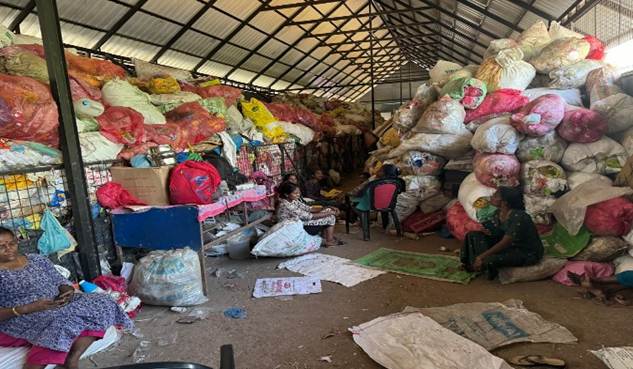
*This image shows the Haritha Karma Sena waste collection storehouse and office located in the Parakode region of Adoor Municipality
SUGGESTIONS AND FUTURE DIRECTIONS
Based on the field experiences and findings of the Haritha Karma Sena (HKS) initiative in Adoor Municipality, a set of well-structured recommendations is essential to strengthen the efficiency, inclusivity, and sustainability of waste management operations. The suggestions below address the functional, social, and policy dimensions of HKS and aim to ensure long-term effectiveness, worker welfare, and community participation.
Enhancing Operational Efficiency and Service Quality:
Improving the timeliness of waste collection is a primary area of concern. Occasional delays reported by beneficiaries can be mitigated through better scheduling, adequate staffing, and regular route optimisation. Expanding service coverage to ensure that all households and commercial establishments are included under the HKS framework is equally vital to achieve 100% waste management coverage. Moreover, the introduction of digital monitoring systems under the Information Kerala Mission (IKM) should be further strengthened to enhance accountability and reduce coordination delays. HKS must also ensure infrastructure improvement by expanding storage godowns, improving transportation facilities, and maintaining necessary collection equipment to support uninterrupted operations.
To further ensure reliability, transparency in operations must remain central to HKS activities. Sharing detailed information on collection schedules, recycling initiatives, and financial transactions through public platforms can increase community trust and reduce misinformation. Establishing strong inter-departmental coordination among the Municipality, Junior Health Inspectors (JHIs), councillors, and HKS workers is critical for resolving operational issues swiftly and maintaining effective communication. Regular feedback and grievance redressal systems should be implemented to receive inputs from beneficiaries, thereby ensuring timely corrective action and service enhancement.
Promoting Community Participation and Environmental Awareness:
A sustainable waste management system depends on community participation. Therefore, awareness campaigns must be expanded through schools, neighbourhood associations, and local clubs to promote waste segregation at source and responsible disposal practices. These campaigns should emphasise the environmental consequences of improper waste management, thus reinforcing positive behavioural change. Organising educational workshops and community seminars can further raise awareness of the importance of waste segregation, recycling, and eco-friendly lifestyles.
To encourage public involvement, HKS could implement incentive-based systems for households or wards that demonstrate exemplary performance in segregation, recycling, and waste reduction. Regular competitions, recognition programs, and awards could motivate citizens to engage in sustainable waste practices actively. Transparency in reporting HKS’s achievements, challenges, and goals will also help build trust among citizens and strengthen participatory governance. Establishing volunteer programs and local waste management committees can enhance community involvement, ensuring that waste management becomes a shared civic responsibility rather than a service-dependent activity.
Strengthening Worker Welfare and Skill Development:
The success of Haritha Karma Sena depends heavily on the dedication and well-being of its workforce. Hence, worker safety and welfare must be prioritised through the uninterrupted provision of protective equipment—gloves, masks, uniforms, sanitisers—and periodic health check-ups. An emergency assistance fund should be established to support workers in the event of accidents or health crises related to waste handling. To prevent occupational hazards, regular safety training sessions in collaboration with the Fire Force and Health Department are essential.
In addition, ensuring timely wage disbursement is crucial for maintaining morale and financial stability. Administrative processes should be streamlined to eliminate delays in government grants or consortium payments. The introduction of additional benefits such as health insurance, pensions, paid leave, and accident coverage would further improve job satisfaction and long-term commitment. Continuous skill development programs must be conducted to enhance workers’ technical and digital competencies, particularly in areas such as waste classification, material recycling, and mobile reporting via the Haritha Mithra App[13].
Moreover, creating clear career progression pathways will provide motivation and reduce attrition rates. Workers who perform exceptionally should be recognised through performance-based rewards or promotions. Team-building activities and leadership training programs can enhance group cohesion and foster a sense of belonging among members. It is also essential to improve communication channels between workers and management to ensure that operational issues, grievances, and wage-related matters are promptly addressed.
Ensuring Inclusivity, Empowerment, and Mental Well-being:
Haritha Karma Sena has already demonstrated its role as a platform for empowering women and promoting social inclusion. To maintain this momentum, gender inclusivity must remain a guiding principle. Equal employment opportunities should be provided to both men and women, ensuring a balanced representation in leadership and field operations. Special focus should be placed on marginalised and economically weaker workers by offering flexible work schedules and targeted support mechanisms.
Empowering workers also involves educating them about their rights, labour laws, and entitlements, enabling them to advocate for fair treatment and safe working conditions. To enhance well-being, mental health support services, such as counselling sessions and stress management workshops, should be introduced. Creating a psychologically safe and supportive work environment will help workers better manage occupational stress. Encouraging worker participation in decision-making—such as planning routes, scheduling collections, and community engagement activities—can further instill a sense of ownership and motivation.
Institutional Development and Continuous Evaluation:
For long-term success, institutional mechanisms must be strengthened. Regular evaluation and monitoring systems should be established to assess both worker and beneficiary satisfaction levels. Conducting periodic surveys will help identify operational gaps, policy shortcomings, and opportunities for innovation. These insights can guide the Municipality and Suchitwa Mission in revising operational strategies and policy frameworks.
HKS should also develop a comprehensive data management system to track waste generation patterns, segregation efficiency, recycling outcomes, and worker performance. Continuous documentation and reporting of these indicators will not only improve internal efficiency but also serve as a valuable resource for state-level policy formulation. Collaborative efforts with academic institutions, NGOs, and private recyclers can further enhance innovation and technology adoption in waste processing and environmental education.
The recommendations presented aim to reinforce Haritha Karma Sena’s dual mission—environmental protection and social empowerment. By improving operational timeliness, ensuring worker welfare, expanding awareness initiatives, and fostering community participation, the HKS can evolve into a model of decentralised waste management that embodies Kerala’s vision of sustainability, gender equity, and participatory governance. With consistent policy support, transparent administration, and active citizen participation, the Haritha Karma Sena will remain a pioneering force in promoting cleanliness, recycling, and environmental stewardship across local communities.
CONCLUSION
To conclude, the Haritha Karma Sena, under the Haritha Kerala Mission of the Kerala Government, is an important initiative to address the state's environmental concerns, especially in waste management. The case study conducted as part of the study showcases the effectiveness of Haritha Karma Sena as an important initiative to protect the climate through community participation and a sustainable model of climate protection. Besides, these initiatives promote employability among people, especially women, at the grassroots level. It is more inclusive in the sense of a participatory approach to climate protection and thereby achieving climate justice. Similar types of local initiatives that suit regional aspects need to be formulated by the respective governments. Localised initiatives in climate protection are the means through which sustainable global climate protection could be achieved.
NOTES
HKS: Haritha Karma Sena: A community-based workforce formed to carry out door-to-door collection, segregation, and transportation of non-biodegradable waste across Kerala. Composed mainly of trained women, HKS functions under the Suchitwa Mission and Haritha Keralam Mission.
HKM: Haritha Keralam Mission: A flagship environmental mission of the Government of Kerala focused on sanitation, waste management, water conservation, and organic farming. It provides the broad policy framework within which HKS functions.
SM: Suchitwa Mission: The nodal state agency responsible for sanitation and waste management. It provides technical guidance, operational oversight, and monitoring support for HKS activities.
LSGIs: Local Self-Government Institutions: Includes Panchayats, Municipalities, and Corporations that supervise and coordinate local HKS operations. They provide infrastructure, logistical support, and administrative backing.
MRF: Material Recovery Facility: A specialised centre where collected waste is sorted, cleaned, stored, and handed over to authorised recycling agencies. MRFs form the backbone of Kerala’s circular economy model.
CKC: Clean Kerala Company: A government-owned enterprise responsible for large-scale plastic recycling, waste collection from MRFs, and promoting sustainable material recovery practices.
IKM: Information Kerala Mission: A digital governance agency that develops software systems for local bodies. It created the Haritha Mithra App used to monitor and track HKS operations.
HMA: Haritha Mithra App: A mobile-based platform used by HKS workers for data entry, attendance, waste collection reporting, and monitoring activities, ensuring digital transparency.
CCM: Clean City Mission: A municipal-level initiative that oversees urban cleanliness and sanitation. HKS workers submit daily and monthly waste management reports to the CCM office.
JHI: Junior Health Inspector: Municipal health officials who coordinate city-level sanitation programmes, supervise HKS workers, and ensure compliance with waste management rules.
EPR: Extended Producer Responsibility: A national environmental policy requiring manufacturers to manage and recycle the waste generated by their products. It supports HKS by creating a structured recycling system.
Panchayat: Rural local governance unit that supports HKS through budgeting, scheduling, monitoring, and facilitating awareness campaigns and infrastructure.
Municipality / Corporation: Urban local bodies responsible for managing sanitation, public health, and waste management systems. They coordinate with HKS workers and oversee urban waste governance.
CKI: Clean Kerala Initiative: A state-level programme promoting plastic waste management, recycling awareness, and sustainable environmental practices. It provides key training modules for HKS members.
Godown: A storage centre used for aggregating, sorting, and temporarily storing segregated waste before it is transported to recycling agencies.
LD and HM Plastic Covers: LD: Low-Density Polyethylene; HM: High-Molecular-Weight Polyethylene; These represent different types of plastic waste sorted by HKS. HM and oil covers generally have higher resale value in recycling markets.
Milma Covers: Plastic packaging from products of the Kerala Co-operative Milk Marketing Federation (MILMA). These are segregated separately due to high recycling potential.
Fire Force: Kerala Fire and Rescue Services. They provide essential training in safety protocols, first aid, and hazard handling for HKS workers.
NGO: Non-profit institutions that may partner with HKS for training, research, community awareness, and social empowerment initiatives.